RCBOs vs. a shared RCD: worth the extra cost?
RCBOs save space on the rail but cost a lot more than a separate RCD and breakers. A look at both sides, with the ABB DS301C as an example.
Affiliate disclosure: this post contains Amazon affiliate links, marked with *. As an Amazon Associate I earn from qualifying purchases. If you buy through one of these links, I get a small commission and you pay the same price.
On the last sub-distribution board I planned, I kept running into the same question: a separate RCBO for every circuit or one shared RCD behind several breakers? The answer is “it depends,” on how much you value panel space against how much you value selectivity.
What an RCBO actually is
An RCBO combines a residual current device and a circuit breaker in one housing. It protects against residual currents, say from a damaged cable insulation and against overload and short circuit, exactly like a normal breaker. The alternative is the split setup: one RCD, usually four-pole, with several individual breakers behind it, all sharing that one RCD.
The upside: every circuit on its own
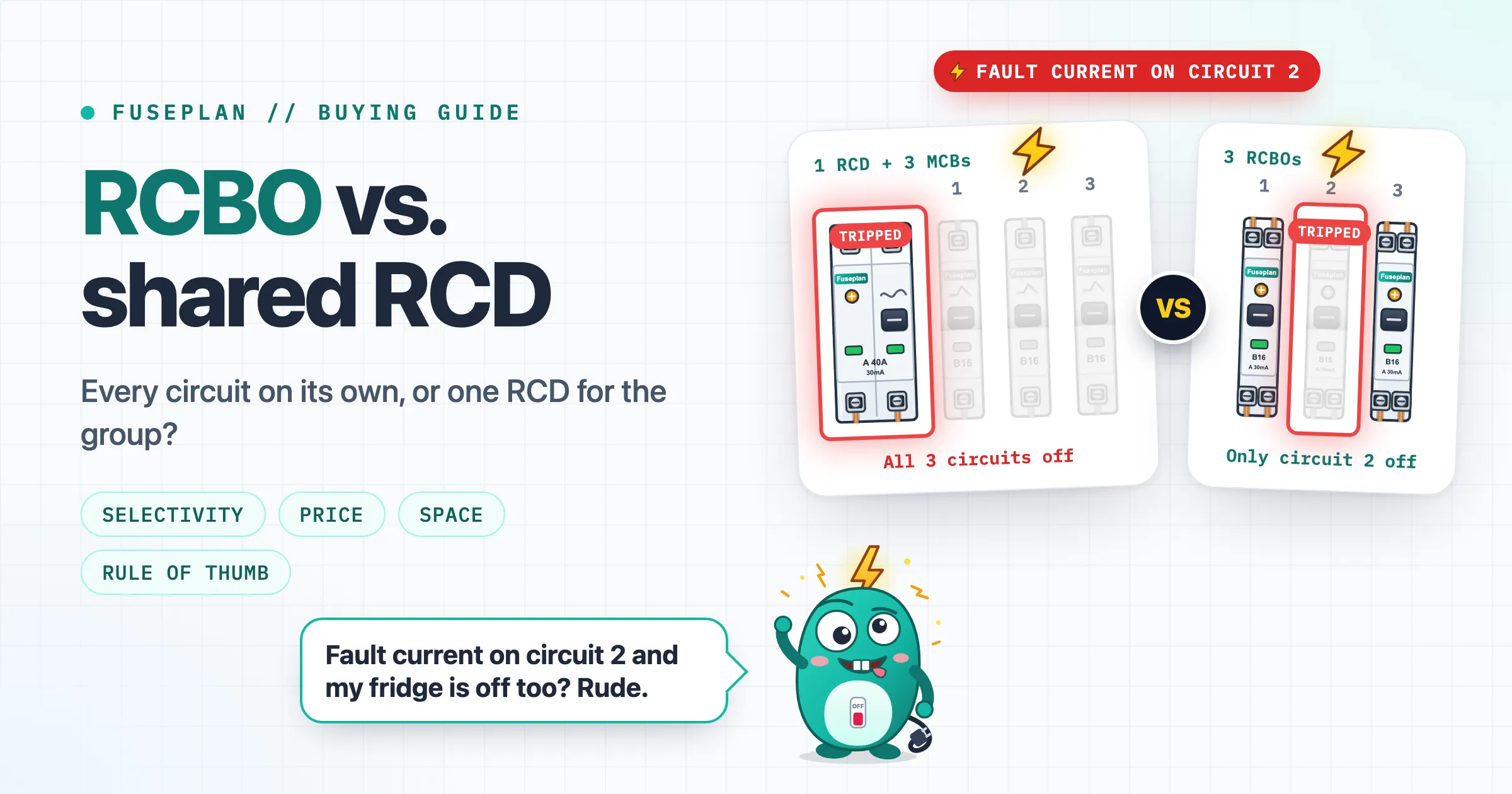
The main reason I still reach for RCBOs in some boards is selectivity. If four circuits share one RCD, a residual current fault on any one of them trips all four at once, including the three that had nothing to do with it. With one RCBO per circuit, only the affected circuit drops out. That matters for a fridge, an aquarium or heating control: I don’t want to lose those circuits just because a residual current fault shows up on a power strip somewhere in the kitchen.
The second advantage is space, but only from one angle. A single RCBO doesn’t take up much room on its own; a lot of modern 1P+N models are barely wider than a plain breaker. But you need one for every circuit, while in a split setup several circuits share a single RCD.
The downside: price and troubleshooting
The math turns against you fast. An RCBO usually costs several times what a single breaker costs and with five circuits you pay that premium five times over. A shared RCD for the same five circuits costs once, plus five cheap breakers behind it. On a bigger board with a lot of circuits, that difference adds up to triple digits quickly.
The second downside is maintenance. When an RCBO trips, it used to be hard to tell at a glance whether it was an overload or a residual current fault; you had to check the switch itself. Most current devices show this through an indicator or a marking on the trip mechanism, but that’s specific to the device and every manufacturer solves it a little differently. And if an RCBO fails, you replace the whole thing, even when only the RCD electronics or only the breaker part is actually at fault.
A concrete example: the ABB DS301C
For individual circuits that deserve their own protection, I use devices like the ABB DS301C B16 A30*: a 1P+N RCBO with B characteristic, 16 A and a 30 mA trip current, type A. Type A covers pulsating DC residual currents, the kind you get from switched-mode power supplies and it’s the right choice for most household circuits. The same series also comes in B10* and B20*, depending on which rated current a given circuit needs.
A quick space calculation
Say you have three circuits that can reasonably share one RCD, lighting in three different rooms, for example. With a split setup you need a four-pole RCD at 2 TE plus three breakers at 1 TE each: 5 TE total for the three circuits. With three individual RCBOs, at roughly 1 to 1.5 TE each depending on the model, you end up at about the same total width, sometimes even a bit more, while paying the RCBO premium three times over for a space advantage that doesn’t actually exist in this case.
The math only flips once you want to pull an individual, important circuit out of a larger RCD group without rebuilding the whole group. Then you just swap that one breaker for an RCBO and leave the rest of the board alone.
My rule of thumb
Normal socket and lighting circuits that can share an RCD anyway get a shared RCD from me. Circuits that shouldn’t drop out because of a fault somewhere else, cooling, an alarm system or home office networking, get their own RCBO, even if it costs more. Fitting an entire panel with nothing but RCBOs is something I rarely see as worthwhile in a normal house; the extra cost is too high next to the actual benefit.
Comments
Write a comment